YOUR CONTRACT HAS ENOUGH MOVING PARTS.
Don’t Let Customer Support Become the Part That Slows Delivery Down.
When inquiries increase, tickets need attention, follow-ups are waiting, and routine questions begin reaching your program managers, the issue may not be your core team.
It may be a customer support function that never had a clear owner.
She’s Here to Assist LLC partners with prime contractors to provide Virtual Customer Support Operations for defined customer-facing portions of State, Local, Higher Education, Workforce Development, 311, and Citizen Services contracts.
We help manage Tier 1 inquiries, tickets, correspondence, follow-up, escalations, and support reporting so your core team can remain focused on contract delivery.
VIRTUAL CUSTOMER SUPPORT OPERATIONS
Customer • Citizen • Student • Participant Support
Tier 1 Support | Inquiry Management | Ticket & Request Management | Escalation Support | FAQ & Knowledge Base Support | Reporting
Virtual Service Delivery Nationwide
Get the Free Prime Contractor Support Coverage Guide
Learn how to identify customer and client support work you may be able to subcontract before it becomes a delivery problem.
Already reviewing an RFP or active contract?
Let’s discuss where SHTA may fit.
Virginia SWaM Certified • Micro Business • eVA Registered • Virtual Delivery Nationwide
NAICS codes:
541611 Administrative Management and General
561499 All Other Business Support Services
561110 Office Administrative Services
561421 Telephone Answering Services
561422 Telemarketing Bureaus and Other Contact Centers
ONE SUPPORT SCOPE. CLEAR RESPONSIBILITIES.
Virtual Customer Support Operations
She’s Here to Assist LLC supports the customer-facing portion of eligible contracts through a defined virtual support role.
Depending on the Statement of Work, our assigned responsibilities may include:

Tier 1 Inquiry Support
Routine customer, citizen, student, participant, and program inquiries using approved FAQs, procedures, scripts, and knowledge resources.
Email, Ticket & Request Management
Shared inbox monitoring, ticket intake, categorization, routing, status updates, follow-up, and documentation.
Escalation & Follow-Up
Identifying requests that require additional authority or expertise, routing them appropriately, and tracking open escalations.
FAQ, Knowledge Base & SOP Support
Maintaining approved responses, FAQs, support documentation, knowledge resources, and frontline procedures.
Support Tracking & Reporting
Tracking inquiry activity, response times, unresolved requests, escalation activity, recurring questions, and applicable service levels.
One specialty. One defined support function. Clear ownership.
None of these tasks may look large by themselves.
But together, they can quietly pull your program managers and specialized staff away from the work they were actually hired to perform.
That’s the Support Gap.
And It’s much easier to plan for it before award than scramble to fix it after implementation.
Let’s discuss where SHTA may fit.
Who Is Actually Going to Handle the Questions?
A participant emails about registration.
A customer needs a status update.
A student cannot find the information they need.
A resident submits a service request.
A ticket needs to be routed.
An issue needs to be escalated.
If the answer is:
“The program manager can probably handle it.”
or
“Someone on the team will monitor the inbox.”
you may have identified a customer support function that needs a clear owner.
Your program managers and subject matter experts can answer routine questions.
The better question is: should they have to?
That is where Virtual Customer Support Operations can fit.
Let’s discuss where SHTA may fit.
Protect Your Core Team’s Time
Your program managers, technical specialists, and subject-matter experts were hired to deliver the contract, not spend their day chasing routine inquiries, monitoring inboxes, and tracking follow-ups.
A defined support partner can give those responsibilities a clear home while helping your core team stay focused on higher-value contract work.
Protect Senior-Team Capacity
Keep routine Tier 1 work away from higher-value staff.Create Clear Ownership
Everyone knows who owns the request and who handles escalation.Improve Responsiveness
Give incoming inquiries consistent coverage.Strengthen Documentation
Keep support activity visible and traceable.Increase Visibility
See recurring issues, open requests, and support trends.
The Goal Isn’t to Add Another Layer of Complexity.
It’s to remove unnecessary work from the people who should be focused on delivering the contract.
SHTA works within a defined role, established workflows, approved procedures, and clear escalation boundaries, so your team knows exactly where our responsibility begins and ends.
With the right support structure in place:
Your core team focuses on delivery.
Routine requests have an owner.
Follow-ups stay visible.
Escalations have a process.
Support activity can be documented and reported.
Already seeing these responsibilities in an upcoming RFP?
Let’s discuss where SHTA may fit.
Not Ready to Talk About a Specific Opportunity Yet?
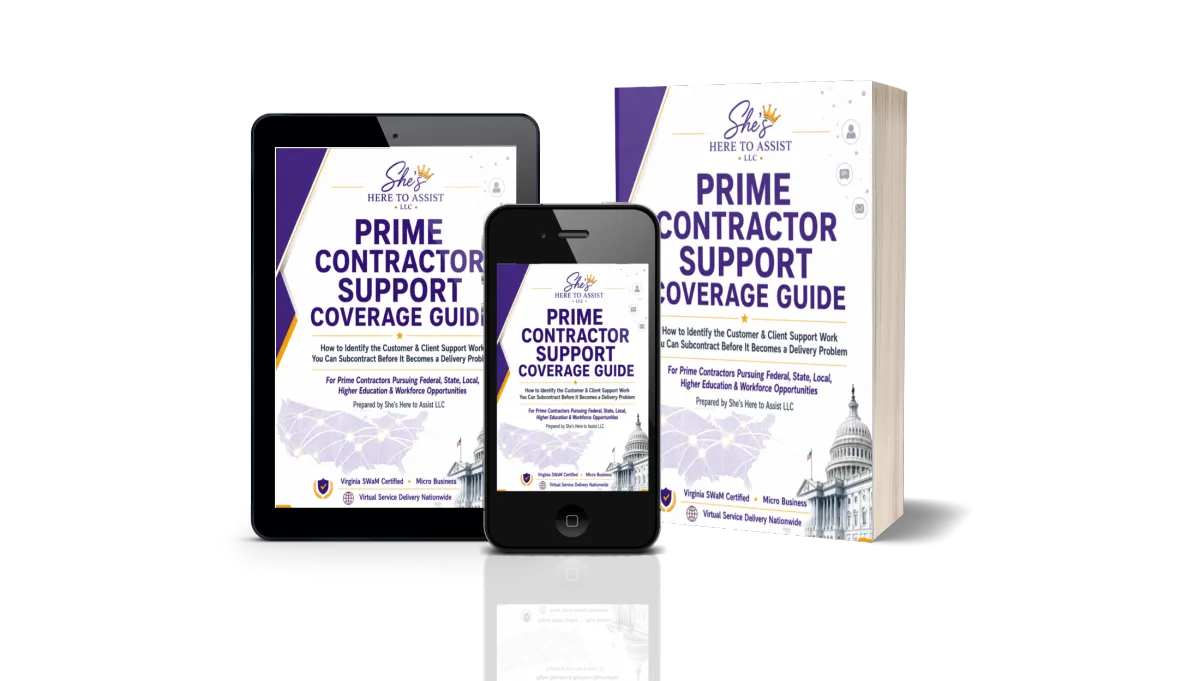
Start With the Prime Contractor Support Coverage Guide.
Before you build another support responsibility into your internal staffing plan, make sure you know what can be separated into a defined support function.
The Prime Contractor Support Coverage Guide will help you identify the customer, client, participant, and Tier 1 support work hiding inside an RFP, before it becomes a delivery problem.
Inside the Guide, You’ll Learn:
How to spot support responsibilities buried inside a Statement of Work
6 support functions to look for when reviewing an RFP
How to determine whether support work should stay internal or be subcontracted
What a strong support subcontractor should help you create
How to identify gaps in inbox, ticket, follow-up, escalation, and reporting coverage
When to start the subcontracting conversation before award
Use It While Reviewing Your Next Opportunity.
Whether you’re:
Reviewing an RFP
Building your subcontracting team
Preparing a proposal
Planning contract staffing
Preparing for implementation
Managing an active contract
…the guide gives you a simple framework for identifying where additional support capacity may be needed.
Get the Free Prime Contractor Support Coverage Guide
Learn how to identify customer and client support work you may be able to subcontract before it becomes a delivery problem.
Working With SHTA Is Simple
You don’t need a complicated onboarding process just to determine whether we’re a fit.
1. Send the Relevant Scope
Share the Statement of Work section, RFP language, or a short description of the support responsibilities you need covered.
2. We Review for Alignment
We identify the areas that match SHTA’s capabilities and discuss the delivery requirements, workflows, tools, response expectations, and reporting needs.
3. We Define the Role
If the opportunity is a fit, we establish what SHTA owns, what remains with your team, and how communication and escalation will work.
4. We Support the Assigned Scope
Once agreements, onboarding, and processes are in place, SHTA delivers the defined support responsibilities within the agreed structure.
You Keep Control of the Contract.
We Help Keep the Support Operation Moving.
Let’s discuss where SHTA may fit.
STILL NOT SURE?
Frequently Asked Questions
Do you only work with Virginia prime contractors?
No. SHTA provides virtual support and is available to explore eligible subcontracting and teaming opportunities with prime contractors nationwide.
Can I contact you before the contract is awarded?
Yes. Pre-award is actually a great time to discuss support coverage while you’re building your staffing and subcontracting strategy.
Do I need to send the entire RFP?
No. Send the relevant Statement of Work section or the portion that contains the customer, client, Tier 1, inquiry-management, coordination, or reporting requirements.
Can SHTA work within our existing systems and processes?
Where authorized and appropriate, yes. Support can be aligned with your approved workflows, platforms, FAQs, SOPs, escalation procedures, and reporting requirements.
What if I don’t have a current opportunity?
Download the Prime Contractor Support Coverage Guide and keep SHTA on your teaming radar for future pursuits.
What type of subcontracting scope should I send you?
Send the section of the Statement of Work that includes customer service, Tier 1 support, help desk, inquiry management, student services, participant support, citizen services, correspondence, ticketing, escalation, FAQ, or support-reporting requirements.
We can review the relevant scope to determine whether it aligns with our Virtual Customer Support Operations capabilities.
Does SHTA provide the software required for my contract?
She’s Here to Assist LLC maintains the standard business equipment and tools required to operate virtually.
When a contract requires a prime-specific or client-specific CRM, ticketing system, help desk platform, telephone system, security software, license, account, or specialized equipment, required access and responsibilities are established in the applicable subcontract, Statement of Work, or agreement.
Let’s discuss where SHTA may fit.
Contact Us
Email: [email protected]
3419 Virginia Beach Blvd. Virginia Beach, VA 23452